What Actually Happens on a Storm Call at Two in the Morning
The calls come in the same order every storm. Here's what the ones ahead of you already learned.
May 19, 2026 · 4 min read
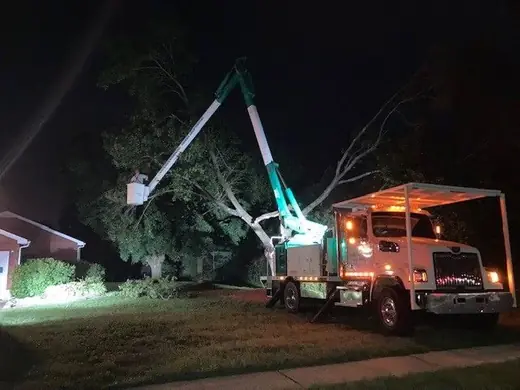
The call almost always sounds the same. A tree came down, sometimes on a roof, sometimes across a driveway or a power line, and it happened in the dark in the middle of a storm that's still going. Whoever's on the other end of the phone is usually calm, but you can hear the wind in the background.
We run 24/7 emergency service for exactly this reason. Storms in this part of New Jersey don't wait for daylight, and a tree leaning on a roofline or blocking the only way out of a driveway isn't something that can sit until morning.
What actually happens once the crew is dispatched
The first job on any storm call is making the immediate area safe, not necessarily removing the tree completely that night. If a tree is resting against a house, the priority is stabilizing it so it can't shift further and do more damage, and identifying any live wires or obvious hazards before anyone gets close. A tree across a driveway that isn't touching a structure or a power line is a more straightforward cut and clear, even at night, with the crew working under portable lighting.
Whether the tree comes down entirely that night or gets stabilized until daylight depends on the specific situation: what it's resting on, how it's angled, whether there's a live wire anywhere near it, and how much can safely be seen in the dark even with lights on. A tree leaning on a roof gets handled differently than one blocking a driveway, because the risk of a shift or a second fall is different in each case.
What a homeowner should do before the crew arrives
- Stay well back from the tree itself and out from under any part of it that's still standing or leaning
- Do not go near any downed line. Treat every line as live until a professional confirms otherwise
- If it's safe to do so from inside, note whether the tree touched a power line on its way down. That changes how the call gets handled
- Keep pets and kids away from the area entirely. Storm-damaged wood and shifted branches are unpredictable
- Take a few photos from a safe distance if you can. They help for insurance later, but this isn't something to prioritize over staying clear of the tree
What we'd ask a homeowner not to do is try to move any part of the tree, even a smaller branch, before someone with the right equipment has looked at it. A branch that looks like it's holding still can be under more tension than it appears, especially when a larger limb is bent instead of fully broken.
Why the order of operations isn't random
A single storm call rarely involves just one problem. The same wind event that put a tree on a roof might also have taken down a smaller limb across the driveway and cracked a large branch that hasn't fallen yet but is clearly going to. The crew works the most dangerous item first, whatever is closest to a person, a structure, or a live line. A limb that is cracked but still hanging is often more dangerous than one already on the ground, because it can let go with no further warning and with more force than its size suggests.
This is also why a crew arriving at night sometimes spends the first several minutes just assessing before a single cut is made. Portable lighting helps, but it doesn't replace daylight, and a tree that's shifted onto a roofline needs to be read correctly before anyone touches it: which way it wants to move if it's cut, what it's actually resting on, and whether cutting it now would relieve pressure on the house or transfer more weight onto it.
After the storm passes
Once the immediate hazard is handled, full cleanup and removal follow, along with grinding whatever stump is left and hauling off the debris. Storm damage clean-up is part of the same tree services work we do on planned jobs, it just happens on a different schedule. We don't subcontract any of it out. The same crew that shows up at two in the morning is the one that finishes the job once the storm has passed, and that continuity matters when a property has more than one tree down and more than one thing that needs fixing.
It's also worth having any large trees near the house looked at before the next storm rather than after. A tree with a visible lean, a split trunk, or dead limbs overhead is a known risk sitting in plain sight, and dealing with it on a calm afternoon is a very different job than dealing with it once it's already come down in the dark.
If you're dealing with storm damage right now, or you want a property looked at before the next one hits so you know which trees are the ones to worry about, we offer free estimates either way.
Countryside Tree Experts, (908) 638-9405
Call (908) 638-9405More articles
Emerald Ash Borer in Hunterdon County: Which Ash Trees Can Still Be Treated
A guide to reading the signs before deciding whether to treat an ash tree or take it down.
When a Tree Has to Come Off a Crane Instead of Being Felled
A felled tree needs open space to fall into. Not every yard has it.