Emerald Ash Borer in Hunterdon County: Which Ash Trees Can Still Be Treated
A guide to reading the signs before deciding whether to treat an ash tree or take it down.
March 11, 2026 · 4 min read
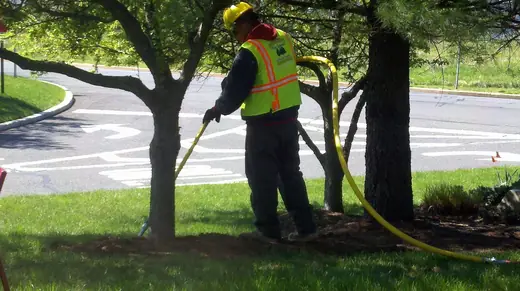
Emerald Ash Borer showed up in New Jersey more than a decade ago, and by now most of Hunterdon County's ash trees have been through some stage of infestation. The insect is small, metallic green, and easy to miss until the tree is already in trouble. What is not easy to miss is the damage: a healthy ash can go from a full canopy to dead limbs in two or three seasons once the borer gets established underneath the bark.
The larvae are the real problem, not the adult beetle. They tunnel through the cambium layer just under the bark, the layer that moves water and nutrients up and down the trunk. Enough tunnels and the tree can no longer move water to its own leaves. That's why an infested ash often shows dieback at the very top of the crown first, the part furthest from the roots and the last to get whatever water is left.
The signs worth checking before you decide anything
- Thinning or dead branches at the top of the crown while the lower branches still look fine
- Bark that splits vertically, showing S-shaped tunnels underneath (woodpecker damage is often the first visible clue, since they're hunting the larvae)
- D-shaped exit holes in the bark, about the width of a grain of rice
- New shoots sprouting low on the trunk or from the roots, a sign the tree is under stress and trying to survive
- Canopy loss of more than 30 percent
If canopy loss is under about 30 percent and the trunk and main limbs are still structurally sound, that tree is usually still a treatment candidate. Once canopy loss passes 50 percent, treatment success rates drop fast, and past that point the more honest conversation is about removal rather than treatment, because a dead or dying ash near a house or a driveway is a liability that only gets worse while it's left standing.
Why timing matters more than most homeowners expect
Treatment for Emerald Ash Borer works by getting insecticide into the vascular tissue the borer is destroying. If too much of that tissue is already gone, there's nowhere for the treatment to go and nothing left to protect. That's why waiting a season 'to see how it does' is usually the wrong call. An ash that looks like it has a little thinning in the spring can be past saving by fall, especially if the previous year's larvae are still in the wood finishing their damage.
This is also where a licensed arborist earns their keep over a guess from the driveway. Our crew includes a licensed arborist on site for every job, and Emerald Ash Borer treatment decisions are one of the places that actually matters, because the visible canopy and the internal damage don't always match. A tree that looks forty percent gone from the ground can have more, or less, structural damage underneath than it appears.
What treatment actually looks like once a tree qualifies
A treatable ash isn't a one-time fix. Effective treatment runs on a repeating schedule, because the insecticide protects the tree for a limited window before it needs to be reapplied. Skipping a scheduled treatment doesn't just pause the protection, it can let the population underneath the bark rebuild to a point where the tree slides from treatable back into decline. This is why we look at Emerald Ash Borer treatment as an ongoing commitment for a homeowner who wants to keep a specific ash rather than a single visit that solves the problem for good.
That ongoing cost is also why the decision to treat versus remove is worth making deliberately rather than by default. A large, healthy shade tree close to a house, one doing real work for cooling or privacy, is often worth the repeat treatment. A smaller or less prominent ash further from the house, especially one already showing meaningful canopy loss, is often not, and putting that money toward removal and a different species in the same spot can be the more sensible call.
What happens to the ones that can't be saved
A dead or dying ash is one of the more dangerous trees to have standing on a property. Dead wood is brittle wood, and Hunterdon County gets enough wind and ice through the winter that a compromised ash near a house, a fence line, or a driveway isn't one to leave standing for now. We handle Emerald Ash Borer removals as part of our tree services work, along with the stump grinding that usually follows, since a dead ash's root system doesn't hold soil the way a living one does, and a rotting stump left in the ground becomes its own long-term problem.
Dead ash wood also loses structural integrity faster than most other species once the borer has finished with it, which is part of why waiting an extra season to decide is riskier with ash than it is with most trees. Bark can begin sloughing off a dead ash within a year or two of death, and once that happens, climbing it safely becomes a much bigger job than removing it while the bark and outer wood are still intact. That's a large part of why we'd rather have the conversation with a homeowner early, while there's still a choice to make, than after the tree has decided the timeline for us.
If a neighbor's property or a stretch of woods nearby has visibly dying ash trees, it's worth having your own checked even if it still looks fine. Emerald Ash Borer moves tree to tree, and a stand of ash in the same area tends to decline on a similar timeline once the insect is established locally.
Free estimates are part of how we handle these calls, since so much of the decision comes down to what the tree actually looks like up close rather than what it looks like from the street.
Countryside Tree Experts, (908) 638-9405
Call (908) 638-9405More articles
What Actually Happens on a Storm Call at Two in the Morning
The calls come in the same order every storm. Here's what the ones ahead of you already learned.
When a Tree Has to Come Off a Crane Instead of Being Felled
A felled tree needs open space to fall into. Not every yard has it.