When a Tree Has to Come Off a Crane Instead of Being Felled
A felled tree needs open space to fall into. Not every yard has it.
June 23, 2026 · 3 min read
Most tree removals are straightforward: cut it down in sections from the top, working toward the trunk, and drop each piece into a clear landing zone. That approach works when there's room for the wood to come down safely, away from the house, the driveway, a fence, or a neighbor's yard.
A crane removal is what happens when that room doesn't exist. If a large tree is close enough to a house, a garage, a pool, or power lines that there's no safe path for a section to fall, cutting and lowering each piece with a crane is the way to take the tree down without putting anything nearby at risk.
How it actually works
A rigging crew in the tree cuts sections free while the crane holds and lowers each piece to a chosen spot on the ground, rather than letting it drop. That gives full control over exactly where the weight goes, which matters when the alternative is a heavy section of trunk swinging toward a roofline or a fence. Once a piece is on the ground, it gets bucked up, chipped, or hauled off the same as any other removal.
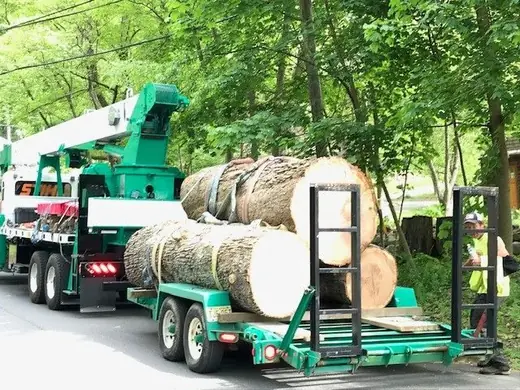
The trucks doing this work carry a crane and a full rigging setup, along with the flatbed needed to haul off the larger sectioned logs once they're down. It's slower and more deliberate than a straightforward felling job, because every cut is planned around where that piece needs to land, not just where it would naturally fall.
Why this is usually the cheaper answer, not the pricier one
It sounds counterintuitive, since a crane costs more to bring to a job than a chainsaw and a clear yard. But the alternative to a crane removal on a tight lot isn't a cheaper version of the same job, it's a much bigger bill if something goes wrong. A tree that has to be felled into a space it doesn't fit, or climbed and cut into pieces that still have to be muscled past a roofline by hand, carries real risk of damage to the house, the deck, a fence, or whatever else is in range. Repairing a roof after a piece of tree comes through it costs far more than the crane did.
A crane removal also tends to be faster overall on a tight property, since the crew isn't spending time rigging complicated rope systems to walk each cut down by hand. Control comes from the machine instead of from a rope and a lot of careful hoping.
What a homeowner can expect on the day
A crane removal takes up more space on site than a standard felling job. The crane itself needs a stable position to set up in, usually the driveway or a section of lawn firm enough to carry its weight, and that spot has to have a clear path to the tree with nothing overhead in the way. Neighbors on either side often notice the truck before anyone even rings a doorbell, and it's fair to expect a longer, more visible job than a typical afternoon removal, precisely because the whole point of the approach is to move slowly and deliberately rather than quickly.
Anyone on the property during a crane job should expect a marked exclusion zone directly under the work area, and should stay well clear of it for the full duration, not just while a piece is visibly being lowered. Rigging can fail in ways that aren't obvious from a distance, and the safest place for a homeowner to watch from is well outside the zone the crew has marked off, not at the edge of it.
How we decide which approach a tree needs
This comes down to a site visit, not a guess over the phone: distance from the house, the angle and lean of the tree, what's underneath it, whether there's a clear drop zone anywhere on the property, and how large the tree actually is once someone is standing under it looking up. A licensed arborist looks at all of that before the removal method gets decided, and free estimates cover exactly this kind of assessment.
If a tree on your property backs right up against the house or sits directly over where a car parks, it's worth having it looked at even if it seems healthy, because the removal method matters more the closer a tree stands to something you don't want damaged.
Countryside Tree Experts, (908) 638-9405
Call (908) 638-9405More articles
Emerald Ash Borer in Hunterdon County: Which Ash Trees Can Still Be Treated
A guide to reading the signs before deciding whether to treat an ash tree or take it down.
What Actually Happens on a Storm Call at Two in the Morning
The calls come in the same order every storm. Here's what the ones ahead of you already learned.