02
Treating the trees worth keeping, and saying so when one is not
Emerald Ash Borer and Spotted Lanternfly treatment, deep root fertilization, root collar excavation and cavity work across Hunterdon County.
Chapter 01
Emerald Ash Borer, and which trees are still worth treating
Emerald Ash Borer is the dominant tree health problem across Countryside's service area right now, and it does not announce itself early. By the time an ash tree looks obviously sick, the insect has often been working under the bark for a while. Some of those trees can still be treated and kept. Others cannot, and the honest answer at that point is removal, not a treatment plan that will not hold.
Dave Vollmer's own trees landed on the other side of that line. His review describes Countryside taking down "several trees on my property, two of which were extremely large dead ash trees," work he called thorough and precisely done. Those two were past treating by the time anyone could have gotten to them. Catching an ash earlier is what keeps that decision from going the same way.
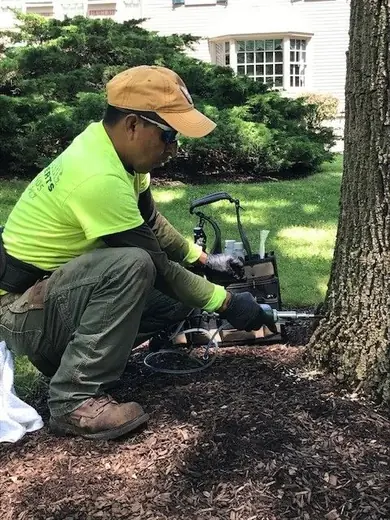
Countryside crew member injecting deep root fertilizer at the base of a residential tree
Spotted Lanternfly
Spotted Lanternfly treatment runs alongside the Emerald Ash Borer program as its own line of work, aimed at an invasive pest that has spread through this part of New Jersey and puts real stress on host trees and plants over a season. It is treated as a distinct problem from ash decline, not folded into one generic spray and called done.
The same crew that treats for Emerald Ash Borer also handles Spotted Lanternfly, which means one company and one visit covers both instead of splitting pest management across separate contractors who never talk to each other about what they found.
Chapter 03
Feeding a tree that is starving, not sick
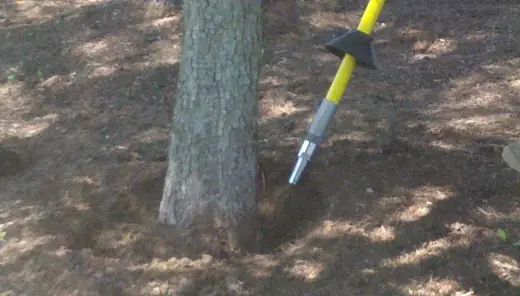
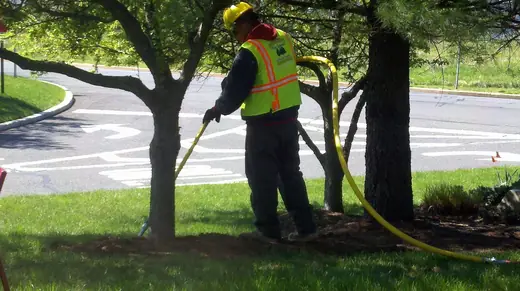
Not every declining tree is diseased. Compacted soil, construction damage nearby, and a root system that simply cannot pull in enough nutrient can leave a tree starving rather than sick, and the fix is feeding it, not spraying it. Deep root fertilization delivers nutrient directly into the root zone where the tree can actually use it, rather than sitting on top of soil the roots cannot reach.
Root collar excavation is the other half of that work: uncovering the base of the trunk where soil, mulch, or years of grading have built up and are smothering the root flare, which over time can girdle and kill a tree that never had a pest or disease problem in the first place.
Cavity work
A cavity in a trunk or a major limb is decay that has already started, and left alone it spreads, weakening the structure from the inside where nobody can see it until a limb fails without warning. Cavity work slows that decay and addresses the structural damage while the tree is still worth saving.
It is plant healthcare in the most literal sense: catching a problem while the tree can still be treated, rather than waiting until the only honest option left is the same crane and removal crew that handles the trees that did not make it.
Countryside, Fully licensed (NJTC770078) and insured. Call (908) 638-9405.
The rest of the work
Other lines this same crew runs
Tree services
Removal, pruning, stump grinding and crane work, planned or at two in the morning after a storm.
Land clearing
Lots taken from standing timber to buildable ground, with the material chipped and hauled off site.
Land management
Keeping acreage from closing in: brush hogging, forestry mowing and underbrush clearing.
Erosion control
Holding bare ground in place after the trees come out, from hydroseed to silt sock.