Clearing Land in the New Jersey Highlands: Where the Material Goes, and Why Erosion Control Isn't a Separate Job
Clearing a lot is only half finished once the trees are down. The ground underneath still has to hold.
July 28, 2026 · 3 min read
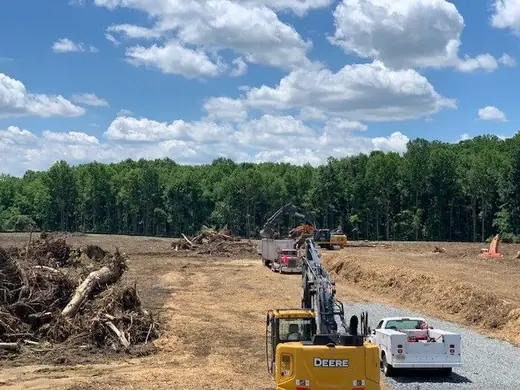
Hunterdon County sits inside the New Jersey Highlands, rolling, wooded, and often steeply graded once you get off the main roads. Clearing a lot here isn't the same job as clearing flat open ground. The terrain holds more standing timber per acre than most people expect, and once that timber and the underbrush beneath it come out, the bare soil left behind is sitting on a slope, exposed to whatever rain comes next.
What actually happens to the material
Lot clearing starts with removing the standing trees, then grinding stumps and root systems out of the ground, since a stump left behind doesn't just look bad, it rots in place and leaves a soft spot that settles unevenly later. Everything that comes down, trunks, limbs, and underbrush, gets processed on site rather than left in piles. Whole-tree chipping turns the brush and smaller material into chips, which can be hauled off or, depending on the job, used to help stabilize the cleared ground itself. Larger trunks get bucked into sections and hauled out on a flatbed.
A cleared lot in flat, sandy soil can often sit exposed for a while without much consequence. A cleared slope in Highlands clay and loam is a different story. Rain runs off graded ground fast, and without something holding the topsoil in place, the first hard rain after clearing can wash a meaningful amount of it straight down the slope, taking nutrients and grading work with it.
Why the erosion plan isn't a separate job
This is the part that gets missed on a lot of clearing jobs done piecemeal, one crew clears the trees, another comes in weeks later to deal with the runoff after the damage is already done. We treat erosion control as part of the same clearing job, because the exposure window between the trees coming down and ground cover being established is exactly when a slope is most vulnerable, and that window shouldn't be left open longer than it has to be.
- Hydroseeding applies a slurry of seed, mulch, and tackifier directly onto graded soil, giving grass a faster start than dry seed and spreading it evenly across uneven ground
- Straw blanketing holds soil in place while hydroseed germinates, especially on any real grade
- Silt sock installation creates a filtered barrier along the low edge of a cleared area, so sediment doesn't wash straight into a neighbor's yard, a storm drain, or a stream
- Erosion blankets go down on steeper sections where straw alone won't hold
- Straw blowing and tacking covers larger cleared areas efficiently once grading is finished
Which combination gets used depends on the actual slope and how the lot drains. A flat building pad needs less than a graded slope running down toward a wooded edge or a neighboring property. This is judged on site, not off a standard package applied to every job the same way.
The equipment involved, and why the mix matters
A wooded lot with real grade usually calls for more than one type of machine working in sequence. Feller-bunchers and forestry-grade equipment take down standing timber efficiently on ground that isn't flat, excavators handle stump grinding and the grading work that follows, and grapple trucks and flatbeds move the larger sectioned logs and cleared material off site. Which combination gets used on a given lot depends on the density of the timber, the steepness of the grade, and how close the cleared area sits to a house, a road, or a neighboring property line that has to stay undisturbed.
None of this is a reason to over-complicate a small, straightforward lot. A modest building pad on relatively level ground doesn't need the same equipment mix as a slope running down to a wooded property line. The point isn't to bring more machinery than a job needs, it's to bring the right machinery for the actual terrain, rather than treating every Hunterdon County lot as though it were flat.
The order that actually protects the ground
Clear, grind stumps, grade if needed, then stabilize, in that order, without a long gap between the clearing and the stabilizing. A lot that sits bare through even one heavy rain in the Highlands can lose enough topsoil that the eventual lawn or build pad ends up needing more grading work than if erosion control had gone in right away. Land clearing and erosion control are both part of what we do, and on a sloped Hunterdon County lot, treating them as one job instead of two is what actually keeps the ground where it belongs.
Countryside Tree Experts, (908) 638-9405
Call (908) 638-9405More articles
Emerald Ash Borer in Hunterdon County: Which Ash Trees Can Still Be Treated
A guide to reading the signs before deciding whether to treat an ash tree or take it down.
What Actually Happens on a Storm Call at Two in the Morning
The calls come in the same order every storm. Here's what the ones ahead of you already learned.